
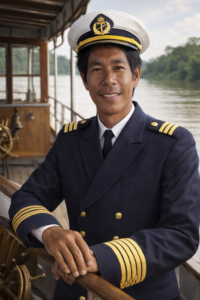
It had been over twenty years—so long that the exact date of his arrival had blurred into the timeless rhythm of the Tonle Sap. He had started as a guide, possessing an uncanny ability to read the water and a gift for storytelling that turned every tour into an odyssey. Yet, it was during the long, quiet scouting trips across the hidden waterways of Cambodia that his true calling emerged.
Together, we had spent decades as modern-day maritime explorers. We’ve chased rumors of “ghost ships” through the tangled mangroves of the south and navigated the narrowest tributaries of the upper Mekong in search of abandoned hulls. There is a specific kind of magic in finding a forgotten, rusted vessel and seeing not its decay, but its potential.
Mony was always the first one to jump overboard into the waist-deep mud to inspect a keel. He’d run his hands over weathered steel or rotting teak with the reverence of a monk, eventually looking up with that signature grin. “She can float again,” he’d say. And because it was Mony saying it, it was the truth.
He transitioned from the man who explained the river to the man who mastered it. When the time came to build, Mony was the indispensable “go-to.” Whether it was calculating the weight distribution for a new solar array or supervising the precision of a hull restoration, his intuition for naval engineering was unmatched. He didn’t just understand how boats worked; he understood how they felt.
Despite the long hours spent under the relentless Cambodian sun or the weeks away on scouting expeditions, Mony’s foundation remained unshakable. Every time the boat docked, his thoughts immediately turned to home. He is a man who treasures the quiet strength of his wife—his greatest supporter through every ambitious build—and the laughter of his children. For Mony, every boat he helped resurrect and every mile he logged as Captain was ultimately for them, the “fleet” that truly mattered.
As the Queen Tara pulled away from the dock, Mony adjusted his cap and took the wheel. He wasn’t just a captain; he was a custodian of the river’s history, a master builder, and a man who had turned a job into a two-decade legacy.