
The Truth About Crossing the Tonle Sap: Why 100% by Boat Isn’t Always the Best Bet
If you’re planning the journey between Phnom Penh and Siem Reap, you’ve likely seen the glossy photos: a sleek boat gliding across a shimmering lake under a golden sun. It looks like the ultimate “slow travel” dream.
However, as veteran operators on these waters, we’re going to tell you something most travel agents won’t: Doing the entire 250km journey strictly by boat is often a recipe for a very long, very uncomfortable day.
Here’s why the “100% boat” route can go south, and why our Tara Boats Hybrid Land & River Tour is the smarter way to see the heart of Cambodia.
1. The “Open Water” Boredom Factor
The Tonle Sap is the largest freshwater lake in Southeast Asia. It is massive. When you are in the middle of it, you aren’t seeing floating villages or rare birds—you are seeing a flat, brown horizon for hours on end.
-
The Reality: After the first 45 minutes of “lake life,” the next 4–5 hours of engine noise and heat can become grueling rather than relaxing.
-
The Tara Difference: We skip the monotonous “dead zones” of the open lake. We use comfortable, air-conditioned transport to get you to the most scenic river systems, ensuring every minute you spend on the water is filled with sights, not just spray.
2. The Great Cambodian “Dry” (Water Level Issues)
Cambodia’s water levels fluctuate wildly. During the dry season (roughly November to May), the lake can become so shallow that large boats frequently get stuck in the mud.
-
The Reality: Many travelers booking “100% boat” tours find themselves stranded on sandbars or abruptly moved to a cramped bus at the last minute because the boat can’t clear the channel.
-
The Tara Difference: By utilizing a hybrid model, we aren’t at the mercy of the mud. We know exactly where the water is deep enough to cruise comfortably, ensuring your schedule stays on track regardless of the season.
3. Comfort and Facilities
Let’s be honest: many “express” boats operating the full route are built for speed, not comfort. Think cramped seating, loud engines, and “basic” (to put it kindly) toilet facilities.
-
The Reality: Spending 7+ hours on a vibrating metal hull in 35°C (95°F) heat is a test of endurance, not a vacation.
-
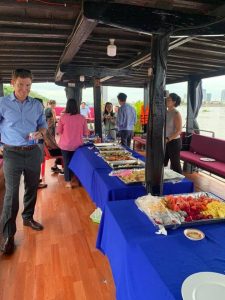
The Tara Difference: We prioritize the “Cruise” in our tour. On our vessels, you have room to move, a freshly prepared meals and cold drinks, We treat the river portion as a gala event, not just a commute.
4. Missing the “Hidden” Cambodia
When you stay strictly on the main water channel, you miss the fascinating life that happens where the road meets the river.
-
The Reality: You bypass the silversmithing villages, the rural markets, and the stilted houses that are only accessible by land-and-water combos.
-
The Tara Difference: Our land legs allow us to stop at traditional silversmithing workshops and rural viewpoints such as a Angkor Era Stone bridge (800 years old) that boat-only passengers never see. You get the best of both worlds: the intimacy of the river and the culture of the countryside.
The Verdict: Work Smarter, Travel Better
Why spend 7+ hours on a boat when you can spend 5 hours enjoying a luxury river cruise (with a cold G&T in hand) and 4 hours in a comfortable, air-conditioned van seeing the Cambodian heartland?
Our hybrid tour is designed for the traveler who wants the magic of the Mekong and Tonle Sap without the “marathon” of a full-day crossing.
Ready to see the real Cambodia? Skip the sandbars and the boredom. [Book your Tara Hybrid Tour here.]